
Tree work for Dayton and the Miami Valley
Tree Service in Dayton, OH
Removals, pruning, stump grinding and storm cleanup, planned around Miami Valley wind, dead ash and big trees on small city lots.
- Free on-site estimates across Dayton and the Miami Valley
- A clear written price, no lump-sum guessing
- Yard left raked and cleared as agreed
Tree Care Built Around Miami Valley Storms
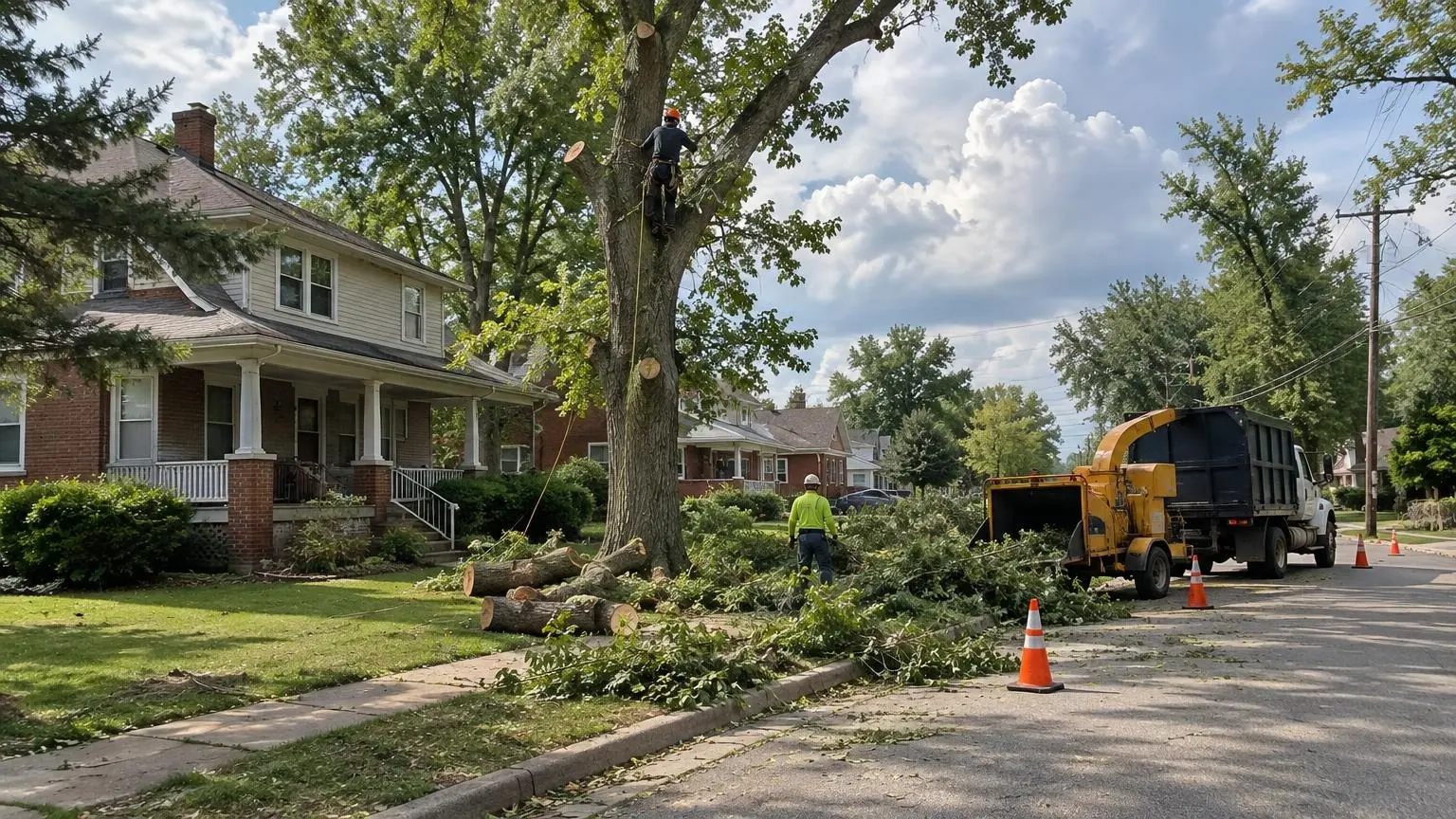
Tree service in Dayton is mostly about wind. The city sits where the Stillwater and Mad rivers meet the Great Miami, in a valley that gets about 41 inches of rain a year, with the wettest month in May, and severe thunderstorms and tornadoes possible from spring into fall. A tree that has carried a heavy, lopsided crown for thirty years can come apart in one July downburst. Most of the trees we are called about in Dayton fall into three groups: trees that are dead or dying, trees that have grown too close to a house, wires or the street, and trees that have just been hit by a storm.
What the 2019 tornadoes taught the valley
On Memorial Day night in 2019, fifteen tornadoes touched down in the Dayton area. The strongest, rated EF4 with peak winds near 170 mph, tracked about 18 miles across Montgomery County from Brookville through Trotwood, Northridge and Old North Dayton to Riverside, and damage surveyors found hardwood trees along the Stillwater River that were snapped and stripped of bark. A separate EF3 from the same storm hit Riverside and Beavercreek. Few storms are that violent, but the everyday version (a straight-line gust, a saturated root zone, a limb with an old crack) brings down trees across the region every year. Pruning out dead wood and reducing long, heavy limbs before storm season costs far less than removing a tree from a roof.
Ash trees after emerald ash borer
Emerald ash borer has been in Ohio since the early 2000s, and around Dayton most untreated ash trees have already died or are dying. The larvae feed under the bark and cut off the tree's water and nutrients from the inside. Signs include thinning at the top of the crown, pale patches where woodpeckers have flaked off bark, small D-shaped exit holes and shoots sprouting from the lower trunk. Dead ash dries out and turns brittle, so a tree that could have been climbed and taken down in sections while it was alive may need a lift or a crane a few years later. A healthy ash of real value can sometimes be protected with insecticide treatment; one that has lost much of its canopy usually cannot.
Old neighborhoods, big trees, close quarters
Dayton peaked at more than 262,000 people in 1960, and much of its housing was built well before that. Neighborhoods such as the Oregon District, St. Anne's Hill, Dayton View, South Park and Huffman have houses set close together, with mature maples, oaks and sycamores that now spread over two or three lots. Census figures show that a little under half of Dayton's homes are owner-occupied, so we also work for landlords who need a dead tree dealt with before it becomes a tenant's problem. On these lots we plan each job around tight access: climbing instead of a bucket truck where a truck cannot reach, sections small enough to carry out by hand, and limbs lowered on ropes instead of dropped.
Street trees, wires and buried lines
Dayton's zoning code says trees in a street right-of-way, which usually includes the strip between the sidewalk and the curb, may not be removed without written approval from the city's Department of Public Works, and a removed tree has to be replaced with a size and species the department accepts. Topping a street tree is prohibited outright. So if a tree you are asking about stands in that strip, we flag it at the estimate and the city's approval comes first. Overhead, AES Ohio's contractors keep its lines at least 10 feet clear, but the service line running from the pole to your house is the owner's to keep clear, which is why branches over that wire show up on so many of our quotes. And because stump grinding digs below the surface, Ohio's 811 one-call system is contacted ahead of time so buried gas, electric and cable lines are marked.
Timing work around Ohio's tree problems
Some work has a best season. Oaks are best pruned in the dormant months, because oak wilt, a fungal disease found in Ohio, can enter through fresh wounds when the sap beetles that carry it are active; the usual Midwest advice is to avoid cutting oaks from April through October. Late winter is a good time for structural pruning on most shade trees, since the branch layout is easy to see. Callery pears (Bradford and similar), planted all over Miami Valley subdivisions, tend to split where several upright limbs grow from one point, and Ohio banned the sale of Callery pear beginning in 2023 because it spreads into fields and woods, so many owners choose to replace them rather than keep repairing them. Storm work, of course, happens whenever the storm does.
What a typical estimate covers
- A look at each tree: species, lean, dead wood, cracks, cavities and decay at the base
- What is underneath: roof, garage, fence, driveway, the neighbor's yard
- Overhead wires and whether the utility needs to be involved first
- Access for a climber, ropes, a chipper or a lift
- What happens to the wood, chips, brush and stump
- A written price per tree, with nothing added unless you approve it
Our Tree Services
Six services handle almost every tree job we see on Dayton-area homes, from a single dead limb to an ash that has to come out before it falls.
Tree Removal
Dead, leaning, storm-weakened and unwanted trees taken down in pieces, with the wood and brush handled the way you choose.
Learn more →Tree Trimming & Pruning
Dead wood out, heavy limbs reduced and clearance restored, using cuts that follow ANSI A300 pruning standards.
Learn more →Stump Grinding
Stumps ground below the surface so you can mow, replant or lay sod, with buried lines marked before we dig.
Learn more →Emergency Storm Tree Service
Trees and limbs on roofs, cars, fences and driveways after Miami Valley storms, removed in order of danger.
Learn more →Ash Tree Removal
Dead and dying ash killed by emerald ash borer taken down safely, before brittle wood makes the job harder.
Learn more →Tree Health Assessments
A close look at a tree that worries you: decay, lean, pests, disease and storm risk, with a plain answer on what to do.
Learn more →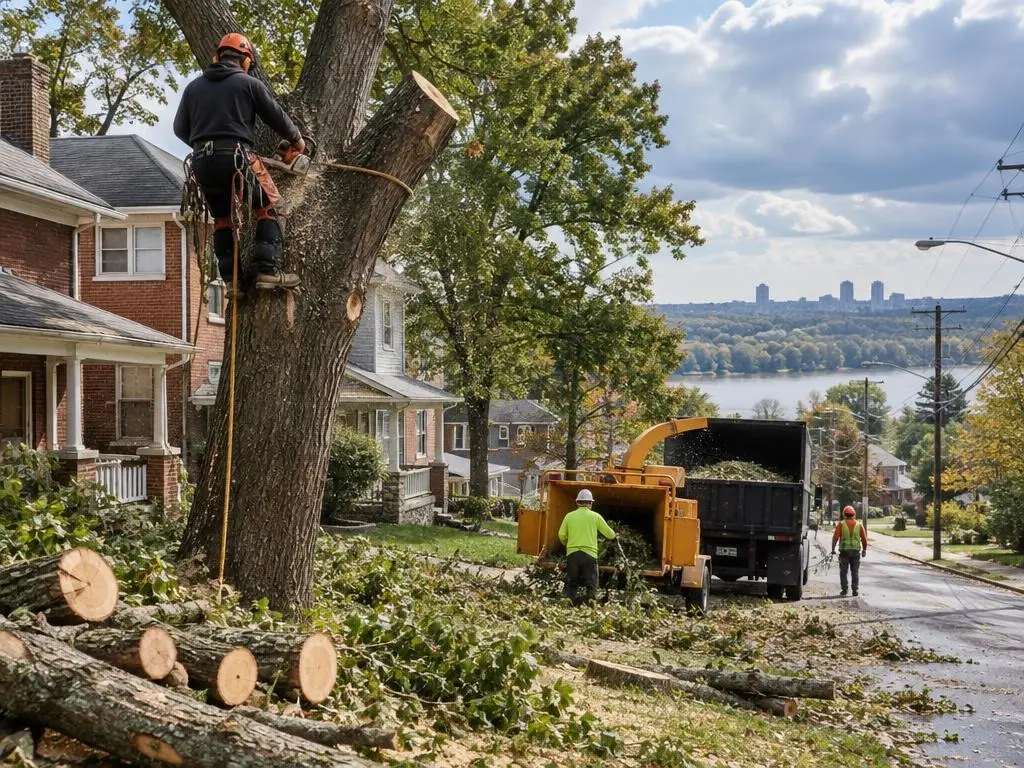
Our Service Area
Dayton is the middle of our service area, and from there we cover most of the Miami Valley. Close in are Oakwood, Kettering, Riverside, Trotwood and Huber Heights; to the south, Centerville, Washington Township, Miamisburg, West Carrollton and Springboro; to the east, Beavercreek, Fairborn and Xenia in Greene County; to the north, Vandalia, Englewood, Clayton, Tipp City and Troy; and to the west, Brookville and Germantown. The older inner suburbs have the biggest, oldest street and yard trees on the smallest lots. The newer subdivisions to the south and north have younger trees, plenty of Callery pears and lots of dead ash along back property lines. Rules on street trees and brush pickup differ from city to city: Kettering requires a right-of-way permit for street-side removals, Centerville takes resident brush at its Public Works Center, and each area page covers what applies there.
- Tree Service in Dayton, OH
- Tree Service in Kettering, OH
- Tree Service in Beavercreek, OH
- Tree Service in Huber Heights, OH
- Tree Service in Centerville, OH
- Tree Service in Oakwood, OH
- Tree Service in Trotwood, OH
- Tree Service in Fairborn, OH
- Tree Service in Xenia, OH
- Tree Service in Miamisburg, OH
- Tree Service in Troy, OH
- Tree Service in Piqua, OH
- Tree Service in Vandalia, OH
- Tree Service in Englewood, OH
- Tree Service in Riverside, OH
- Tree Service in West Carrollton, OH
- Tree Service in Springboro, OH
- Tree Service in Tipp City, OH
- Tree Service in Bellbrook, OH
- Tree Service in Yellow Springs, OH
- Tree Service in Germantown, OH
- Tree Service in Brookville, OH
- Tree Service in Clayton, OH
- Tree Service in Moraine, OH
- Tree Service in Union, OH
- Tree Service in Washington Township, OH
- Tree Service in Springfield, OH
- Tree Service in Sugarcreek Township, OH
- Tree Service in Harrison Township, OH
Why Homeowners Call Dayton Tree Service Pros
We say how each tree comes down
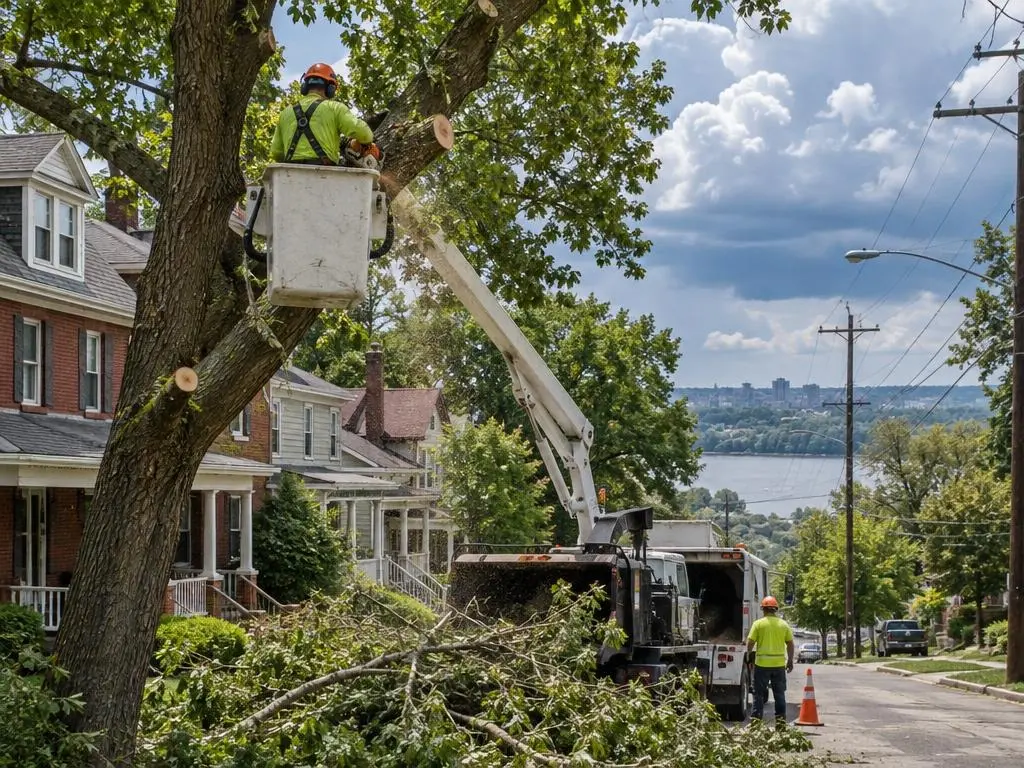
The quote states whether a tree will be felled, taken down in sections, or lowered on ropes, and what is being protected underneath.
Ash trees get an honest call
If an ash is still worth treating we say so; if it is too far gone, we explain why waiting makes removal harder and riskier.
Public trees flagged first
Dayton requires written Public Works approval before a right-of-way tree comes down, so when a tree looks like a street tree we say so before quoting, not after you have paid for work the city may not allow.
No surprise charges
Every tree, every task and the cleanup are priced on paper. Anything extra is agreed in writing before it is done.
Common Questions
How much does tree service cost in Dayton?
It depends most on the tree's height, how close it is to buildings or wires, and how easy it is to reach. HomeAdvisor's 2026 guide puts most removals between about $200 and $2,000, and Homeyou's Dayton figures put a medium tree at roughly $560 to $760. Tight backyards and trees over roofs land at the upper end. Trimming usually costs less than removal. We give a written price after seeing the tree.
Do I need a permit to remove a tree on my property in Dayton?
A tree that stands entirely on your own lot is generally your decision in Dayton. Trees in the street right-of-way, such as most trees between the sidewalk and the curb, are not: the zoning code requires written approval from the Department of Public Works before one is removed, plus a replacement tree the department approves. We point out any tree that looks like it sits in the right-of-way at the estimate.
Who trims trees that are touching power lines?
AES Ohio, the utility for most of the Dayton area, sends its own line-clearance contractors to keep its lines at least 10 feet clear; before circuit work it places an automated call and a planner usually leaves a door hanger. Those crews do not trim around the service line that runs from the pole to your house, and AES leaves keeping that line clear to the property owner. Never cut limbs touching any wire yourself. If branches are resting on the service line, call AES Ohio at 888-582-3213 to talk through making it safe, and then we can handle the tree.
My neighbor's tree hangs over my yard. Can I have it cut back?
In Ohio you can generally trim branches that cross onto your side of the line, but you cannot damage the tree itself. Ohio law makes a person who recklessly cuts or injures a tree on someone else's land liable for up to three times the damage, so talk to your neighbor first and keep cuts at the property line. We prune to the line without topping or harming the tree.
Is it worth saving an ash tree in Dayton?
Sometimes. A healthy ash with most of its canopy intact can often be protected with insecticide treatment repeated every few years. An ash that has lost a third or more of its crown, or shows heavy woodpecker damage and bark splits, is usually past saving. Because dead ash becomes brittle, an ash near a house, driveway or street is best dealt with before it dies.
When is the best time to trim trees in southwest Ohio?
Late winter, while trees are dormant, works well for most shade trees: the structure is easy to see and cuts close quickly in spring. Oaks should be pruned from about November through March to avoid spreading oak wilt. Dead or broken limbs over a roof or driveway can come off any time of year.
Can I find a tree company near me for emergency storm damage?
Call (937) 884-1695 and leave the address, what fell and what it hit, and we will call back to work out the next step. If a tree is on a power line, stay well away and call the utility first. Trees on houses and trees blocking a way out get the earliest visits after a storm.
Do you grind the stump when you remove a tree?
Only if you want it. Stump grinding is priced as its own line on the quote so you can choose. Many people grind it the same day; others leave it for later or keep it as a base for a planter.
Get a Tree Service Estimate
Free on-site estimates in Dayton and nearby Miami Valley towns, with a written quote before any work.